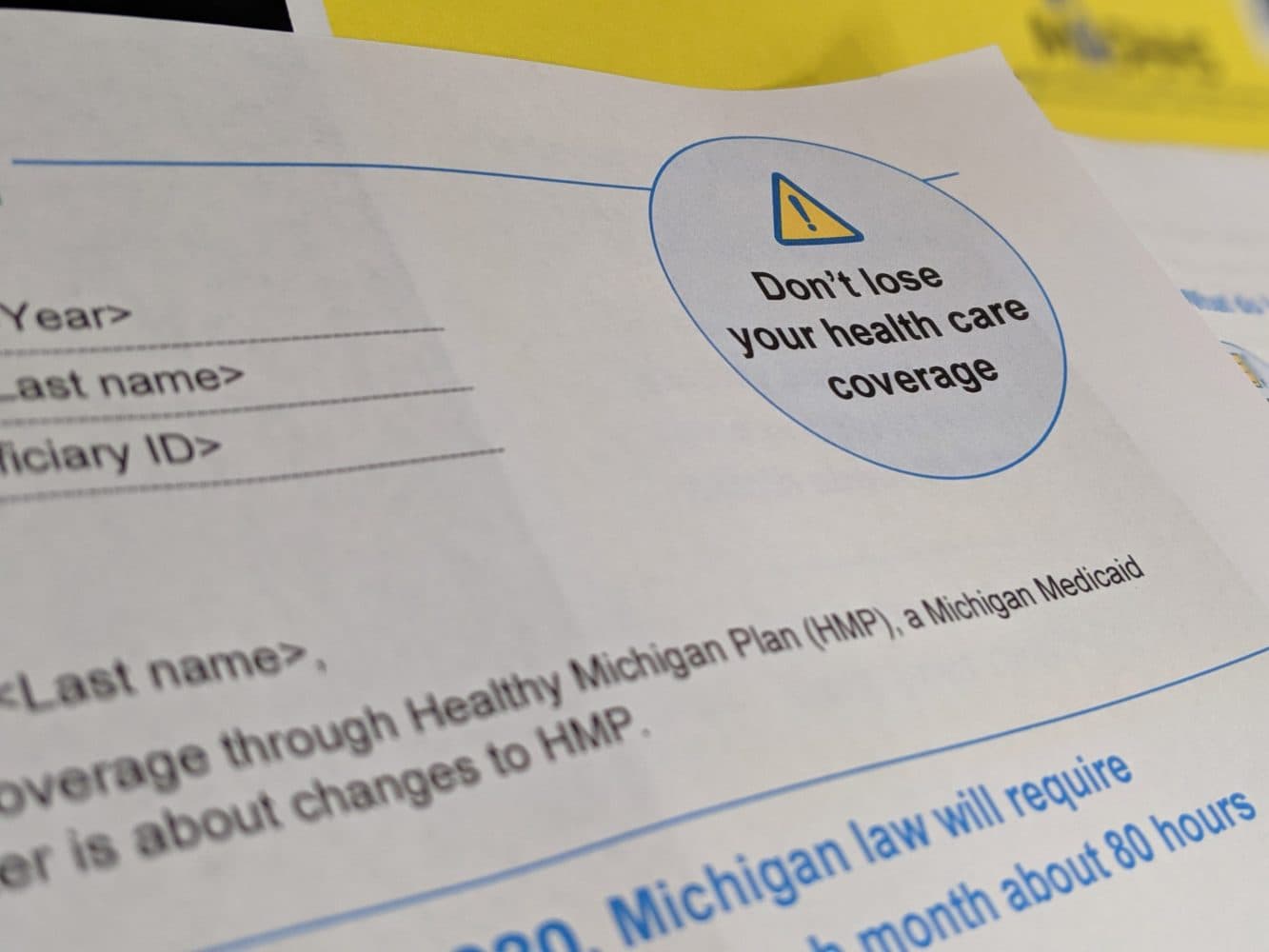


- New rules will mean more paperwork, proof to keep Michigan’s Medicaid
- Work requirements apply only to those in ‘expanded Medicaid,’ known as the Healthy Michigan Plan
- Beneficiaries should start receiving notices this month
Hundreds of thousands of working-age Michiganders will face new paperwork requirements to keep their Medicaid coverage, beginning next year.
In addition to “work requirements,” those beneficiaries also will have to verify twice a year that they’re eligible for coverage. As it stands now, Medicaid eligibility is reviewed just once a year.
The changes are the result of the 2025 budget reconciliation bill — the “One, Big Beautiful Bill,” as it’s known — that was signed into law on July 4, 2025.
Carrying out the changes will be a heavy lift for the state, too.
It will mean dramatically reworked processes and possibly more staff. The Whitmer administration has estimated it will cost about $186.6 million to prepare the state for what she calls “burdensome federal requirements” not only for Medicaid, but also for the Supplemental Nutrition Assistance Program, or SNAP.
Some of those state funds would backfill dwindling federal funds, but other funds would be used to boost staffing, training and oversight.
Here’s some of what we know already:
Who falls under new work requirements?
Medicaid beneficiaries 19-64 years old who are part of what’s known as “Medicaid expansion” will be subject to the new work requirements.
In Michigan, those are people who are covered by the Healthy Michigan Plan, which at the end of April covered nearly 700,000 Michiganders.
That can be confusing though.
Commercial insurers provide those plans, so a beneficiary may not realize the Blue Cross Blue Shield or Health Alliance Plan card they carry in their wallet is part of Healthy Michigan.
If you don’t get insurance through your employer, at the federal marketplace, known as www.healthcare.gov or through Medicare, there’s a good chance you get Medicaid. About 2.7 Michiganders now are covered by traditional Medicaid programs, but about 678,000 are in the expansion part of the program known as Healthy Michigan.
The Whitmer administration has estimated that up to 200,000 residents will lose coverage under the new requirements, including some who are eligible, but fail to submit all their necessary documentation.
When do Medicaid work requirements take effect?
Rules are effective Jan. 1, 2027. A first cohort of Michiganders must submit paperwork by March 31 of next year or lose coverage.
This cohort will also be the first beneficiaries whose eligibility will have to be renewed every six months as well.
What do I have to do?
Those who face work requirements must provide proof of “80 hours per month of qualifying activities, such as employment, participation in certain work programs, or community service, or be enrolled in [an] educational program at least half time,” according to the US Centers for Medicare and Medicaid.
Those activities can be combined.
If the state cannot verify your eligibility, it is required to send a notice of noncompliance and provide you 30 calendar days to appeal.
Those who are affected will be notified by mail, in online accounts or, in some cases, by text message.
Are there exceptions?
Some parents, pregnant people and people with disabilities will be exempt.
Specifically, the US Centers for Medicare and Medicaid Services outlines these exceptions:
- Former foster care youth
- American Indians and Alaska Natives
- Parents, guardians, caretaker relatives, or family caregivers of a dependent child 13 years of age and under, or a disabled individual;
- Veterans with a total disability rating
- People who are medically frail or otherwise have special medical needs that significantly impair their ability to comply with the requirement
- Members of households receiving Supplemental Nutrition Assistance Program who are already subject to work requirements
- Participants in a drug or alcohol rehabilitation or treatment program;
- Inmates of a public institution
- People who are pregnant or eligible for postpartum coverage
What about immigrants?
Certain non-citizens also face changes.
The following people will continue to be covered by full Medicaid if they meet all other eligibility provisions:
- Lawful permanent residents after the 5-year waiting period
- Cuban/Haitian entrants
- Migrants who fall under the Compacts of Free Association
Beginning Oct. 1, 2026, other non-citizens will be moved to coverage for emergency services only, which includes treatment for an emergency medical condition that has severe symptoms requiring immediate medical attention.
Emergency-only coverage excludes routine doctor visits, preventive care, ongoing treatment for chronic conditions, most prescription medications and non-emergency procedures.
What’s Michigan doing to prepare?
Michiganders covered by Medicaid may start seeing “awareness notices” this month, but formal notices will be distributed in September.
Beneficiaries due for renewal in March 2027 will be the first cohort required to submit proof of meeting work requirements. If they fail to submit the proper paperwork, coverage ends for this first cohort on March 31 of next year.
This same cohort will also be the first to face twice-annual renewals.
Weren’t we here before?
Yep. Back in 2019 and 2020, Michigan and other states were gearing up for work requirements over protests by the Whitmer administration.
Arkansas and Georgia implemented their rules first, and thousands immediately lost coverage. Those states have since continued work requirements.
The mandate in Michigan eventually stalled after a court challenge by Whitmer. Then, in 2020, pandemic-era rules restricted states from kicking anyone off Medicaid, with rare exceptions.